The Quiet Ceremony: A Register Office Wedding Gallery in Twenty Minutes Flat
Register office weddings have a reputation for being brisk. You arrive, you wait, you go in, you say the words, you sign the book, you come out, and suddenly everyone is looking at their watches because the next part of the day has a booking time. In 2026, with so many couples choosing a small civil ceremony before a meal, a party or a train, that short window is more common than ever. It can also be one of the most photographically generous weddings you will ever attend — if you plan for the gaps rather than the grand entrance.
The trick is not to turn twenty minutes into a production. It is to treat those twenty minutes as a complete little story: arrival, nerves, the ceremony itself, the exit, the relief, the two people who stood beside you, and the walk back into ordinary life. That is a full gallery. It just needs a route.
Start with the timetable, not the shot list
Before I think about lenses or locations, I ask the couple for the actual running order. What time is the appointment? What time do they need to arrive? How long is the ceremony expected to take? Is there a signing table, a separate waiting area, a flight of steps, a lift, a second appointment straight after theirs? And what is happening next — lunch, a pub, a train, a taxi to the reception?
That last question matters most. A register office wedding is rarely the whole day; it is the opening chapter. If the couple has a table booked for 1pm and the ceremony is at 12.20pm, the portrait window is not an hour. It is the walk from the door to the car, plus whatever you can steal before everyone gets cold. Knowing that in advance stops the day from feeling rushed. It also stops you from asking for photographs at the exact moment a registrar is politely trying to reset the room.
I also ask about the two witnesses. In a small civil ceremony they are not extras. They are usually the people who drove, held the rings, minded the bag, calmed the nerves and will be in the photographs that the couple actually print. Give them a role in the plan. One can hold the bouquet. One can hold the umbrella. Both can stand close during the group photographs rather than hovering at the edge like they are waiting for a bus.
Scout a ten-minute radius
Once I know the timings, I walk the area around the register office. Not an hour before the wedding — on a separate day, if possible, at roughly the same time. Natural light is bossy. A doorway that looks lovely at 10am can be a black hole at 2pm, and a high street that feels busy and bright can turn into a wind tunnel by the time the ceremony ends.
I am looking for three things: a covered spot, an open spot and a transitional spot. The covered spot is the rain plan — an arcade, a deep shopfront awning, a colonnade, a porch, a station canopy, a covered market entrance. The open spot is somewhere with soft, even light: a north-facing wall, a park path, a wide pavement with a pale building opposite. The transitional spot is the bit between them, because the best photographs often happen while people are moving and not yet posing.
Ask about permissions before you rely on a private doorway or a shop entrance. Most places are kind if you ask, but a register office wedding does not need a confrontation with a manager. Public pavement, public park, the building's own steps and any area the venue has agreed to are enough. A wedding gallery is not improved by a couple being told to move along.
The twenty-minute route
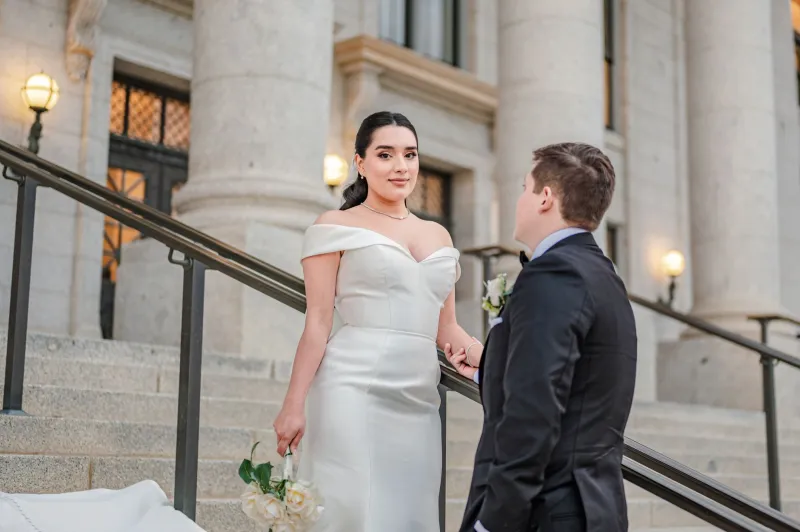
My preferred route is simple and circular. The first five minutes are for arrival and the doorway: the couple walking in, the witnesses behind them, the last check of a jacket, the quiet laugh before the door opens. Then five minutes under cover — this is where I photograph the immediate after-ceremony relief, the first look at the rings, the certificate folder, the hugs with the witnesses. If the weather is kind, the next five minutes are outside in the open light for a handful of loose portraits. The final five minutes are the walk back towards the car, the pub or the next appointment.
That is not a rigid schedule. It is a shape. If the ceremony runs late, the route shrinks. If the couple wants to spend ten minutes talking to the registrar, the route waits. The point is that nobody has to stand in the cold while I hunt for a background. I already know where we are going.
In rain, the route changes but does not collapse. The covered spot becomes the studio. A doorway with a white wall and soft daylight can hold a family group, a couple portrait and a detail shot. An umbrella can be a prop rather than a problem. If the couple has booked a table nearby, I might walk with them and use the pub window or the restaurant doorway. The photographs do not need to prove the weather was perfect. They need to prove the day was theirs.
Directing without turning it into a shoot
Small weddings can go one of two ways. Either everyone stands stiffly because they are not sure what to do, or someone suggests a big formal line-up and the intimacy disappears. I aim for the middle. I give the couple something to do rather than a pose to hold.
A few prompts I use: walk towards me and tell me the worst part of the morning. Hold hands like you are waiting for a bus you do not really want to catch. Whisper the first song you danced to. Look at your witness and try not to laugh. These are not tricks to manufacture emotion; they are ways to give people a job so their faces stop performing. The best frame is often the one just after the prompt, when the couple has forgotten I am there.
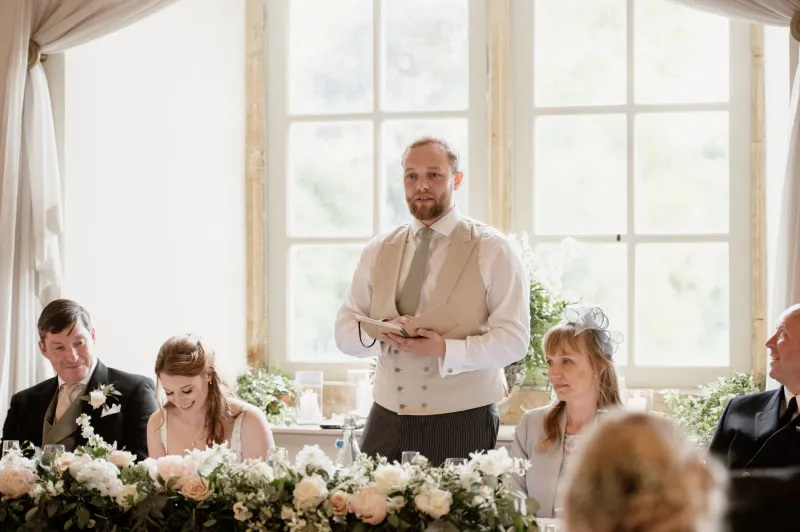
With witnesses, I keep it light. I might ask one to tell the couple something they have never told them before, or ask both to stand close and just talk among themselves for thirty seconds. That usually produces the photograph that feels like the day: a little messy, a little funny, entirely real.
Venue staff deserve the same courtesy. I introduce myself, ask where I should stand, and check whether photography is allowed during the signing. Rules vary, and it is better to know before the registrar is halfway through a sentence. A quiet question at the start is worth more than a flash in the wrong moment.
What to photograph when time is tight
When the window is short, I stop chasing a full shot list and start looking for the story beats. The arrival. The witnesses in the waiting area. The couple's hands. The rings. The register office door. The exit. The first hug. The certificate. The walk away. A handful of loose portraits. One group of four. Maybe a detail of the bouquet or the shoes if they matter to the couple.
That is enough. A register office wedding gallery does not need forty group combinations. It needs the feeling of a small room, a short ceremony and two people choosing each other in front of the people who showed up. If the couple has a party later, the gallery can end on the pavement with everyone heading off in different directions — which is exactly how the day will feel.
Back at the edit, I keep the colour warm and natural, and I let a few frames go black and white where the gesture matters more than the colour. The gallery is sequenced like the morning: nerves, ceremony, relief, laughter, goodbye. Twenty minutes can hold all of that. It just needs someone to notice it.