Radiators, Robes and the Last Good Window: Winter Bridal Prep Without Flash
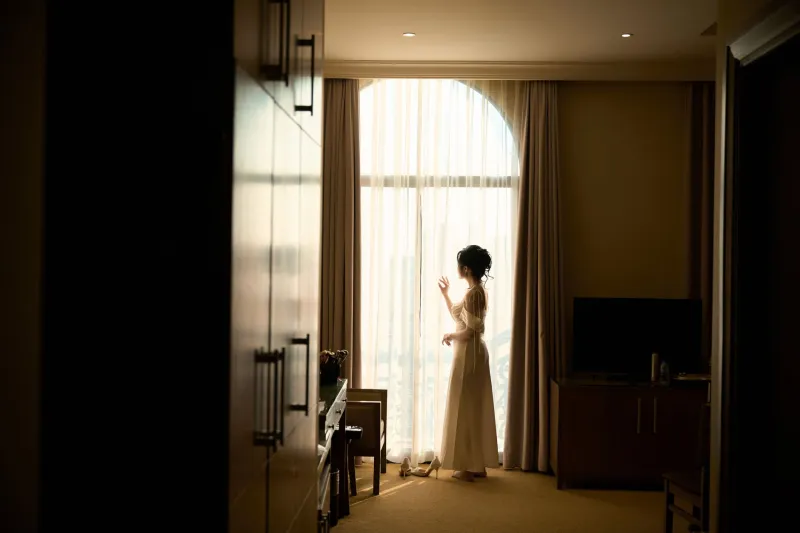
Winter bridal prep has a particular flavour. The heating is on too high, someone has brought a flask, the hairdresser needs a plug socket, and the room you have been given is often the smallest bedroom in the building. There is one window. It is probably grey outside. And somehow, from that, you are meant to make a set of photographs that feel warm, honest and full of the morning.
The good news is that you do not need much. You need a window, a bit of patience and a plan that does not fight the room. Flash is rarely the answer in these spaces. It flattens the very thing that makes bridal prep feel real: the soft, shifting, slightly imperfect light of a winter morning.
Start with the room, not the dress
When I arrive at bridal prep, I do not immediately ask to see the dress. I ask which way the window faces and where the bride is planning to sit. Those two answers shape everything else.
In most UK winter wedding venues, the bridal suite is a converted bedroom with a sash window, a radiator underneath it and a mirror on the wardrobe door. That is workable. The first job is to clear the windowsill, not to redecorate. Move the clutter that catches the eye: empty cups, phone chargers, plastic bags, the coat pile on the bed. Put them in one corner or, better, in another room. You are not trying to erase the morning. You are trying to stop the camera from tripping over it.
Do not move heavy furniture unless you have to. A bed can be a seat, a table and a soft backdrop. A chest of drawers can hold the shoes and the perfume. The room does not need to look like a hotel brochure. It needs to look like somewhere a person actually got ready.
The window is the key light, but the mirror is the second camera
Position the bride near the window at roughly forty-five degrees, so the light falls across her face rather than straight into it. If the window is very bright, a sheer curtain is your friend. If the room is very dark, a white towel or a pale blanket on the floor can bounce a little light back up. I have used a white dressing gown on a chair more than once.
The mirror is not just for makeup. It can give you a second view of the dress, the veil, the mother doing up the buttons. Shoot into the mirror from the side so you catch the reflection without filling the frame with camera equipment. And keep an eye on what is reflected behind you. A bin bag in the corner will ruin a lovely moment faster than bad light.
Build the timeline around light, not just the hairdresser
In winter, the useful window light often peaks in the late morning and then drops away quickly. If the ceremony is at two o'clock, the best light for bridal portraits may be at eleven. That is not always convenient, but it is worth planning for.
Ask the photographer to arrive two and a half to three hours before the ceremony. Use the early part of that time for details: the dress hanging, the shoes, the jewellery, the invitation, the flowers. Those photographs do not need the bride to be ready. They need a windowsill and five quiet minutes.
When the bride is nearly ready, protect twenty minutes for the portraits. Not an hour. Twenty minutes is enough for the dress, the veil, a few frames with her mum or bridesmaids, and one or two moments on her own. If the schedule slips, cut the group line-ups, not the quiet bit. The quiet bit is the story.
What to move, what to ignore
Move the ironing board. Move the suitcase. Move the stack of wedding cards if they are in a dark corner, but keep a few nearby if they mean something. Turn off the television. Take the security tags off the robes before anyone puts them on. Clear the bedside table of anything that looks like a hospital waiting room.
Ignore the mismatched hangers. Ignore the fact that the carpet is beige. Ignore the slightly tired curtains. A little bit of real life is fine. In fact, it is often better than a perfectly styled room that feels as if nobody has ever slept in it.
Posing in a tight room
Small rooms do not need big poses. Sit the bride on the edge of the bed with her hands in her lap. Stand her by the window with the veil falling behind her. Use the doorway as a frame. Put the bridesmaids at different heights on the bed and the chair so nobody forms a police line-up. Keep everyone close enough to touch. That is what makes the room feel warm.
Avoid shooting from the far corner with a wide lens unless you want everyone to look like they are in a carry-on suitcase. A 35mm or 50mm lens is usually plenty. Step back if you can. If you cannot, crop later.
The ten minutes that matter
After the dress is on and before the car arrives, ask everyone except the bride and one person she trusts to step out. This is not a dramatic moment. It is usually the opposite. Someone is doing up the last button. Someone is holding the bouquet. Someone is trying not to cry. Photograph that.
Those frames are the ones that will make the gallery feel like the morning. Not the perfectly arranged shoes by the window, although those are nice too. The ten minutes of calm are what winter bridal prep is actually about.
When the room really is too dark
Sometimes the window is tiny and the walls are a deep colour. In that case, do not force it. Move to the hallway, the stairwell or the bathroom if the light is better. Stairwells are underrated. So are wide landings and front doors with glass panels.
If you must stay in the room, raise the ISO, open the aperture and shoot towards the light. Accept a little grain. A slightly grainy photograph of a real moment beats a clean photograph of a stiff one. If a small continuous light is available, bounce it off the ceiling rather than pointing it at anyone's face, and keep it off for the quiet portraits. Natural light first, rescue second.
The short version
One good window is enough. Clear the worst of the clutter, put the bride near the light, use the mirror, and protect a short window of time for the photographs that matter. Winter bridal prep is not a studio session. It is a borrowed bedroom, a cold radiator and a room full of people trying to get someone ready. Photograph that, and the gallery will feel like the morning it actually was.