Everyone In, Ninety Seconds: The Big Christmas Group Shot Without the Assembly-Hall Feeling
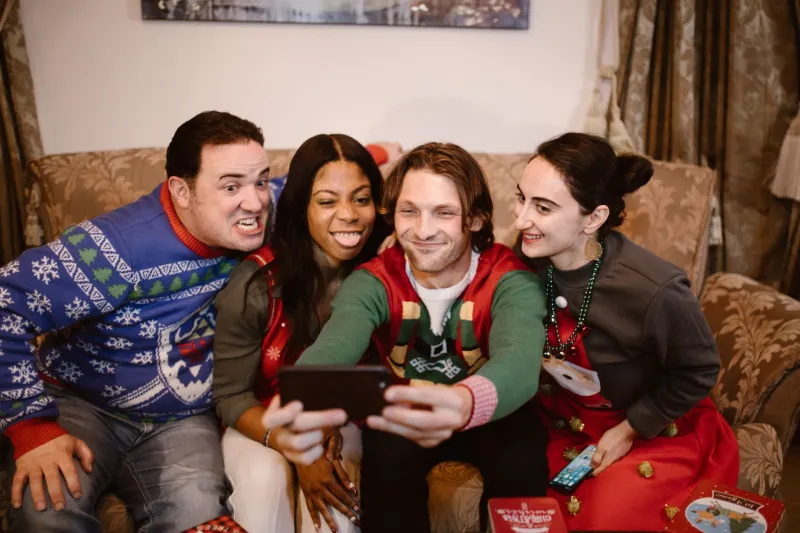
Every December I get the same request, and it always arrives at the worst possible moment — mulled wine in one hand, camera in the other, the buffet just opened. "Can we get a photo of everyone?"
It's a lovely thing to be asked. It's also the single most fumbled photograph of the winter season. Someone's in the loo, the tallest cousin is at the back on his phone, grandma's been sat in a chair that puts her at hip height, and the flash fires straight into a window, turning everyone into a pale smear on a black rectangle.
None of that is anyone's fault. Group photographs go wrong because they're done on impulse, at the exact second the room is least organised. So here's the plan I've settled on after a good few winters of Christmas dos, works parties and December weddings: two minutes, one clear shape, three people with jobs, and a handful of backup frames that end up being the ones people actually print.
Scout the spot before the room fills up
I arrive early — not for the canapés, though I won't pretend that's a downside. I want to find the natural-light spot before anyone has hung a coat on it.
In a UK village hall or a hotel function room in December, that usually means a window or a pair of fire doors onto a terrace. Daylight is precious and it's gone by about four o'clock, so the realistic window for a big group shot is the arrival drinks, not after the meal. If the room has a wall of windows facing the car park, that's my spot. If it has a doorway with the string lights visible behind, even better — that's the shot that says this was the night, not this was a school photo.
Two things to avoid. First, mixed light: overhead tungsten fighting a cold grey window gives everyone a strange two-tone face that no amount of editing fully rescues. I'll often ask the venue to dim or kill the nearest bank of downlights for ninety seconds. Second, the shiny fire exit sign directly behind the group. It will appear. It always appears.
Give the crowd a shape, not a line
A straight row of twenty people is a queue, and queues look like waiting. What I want instead is a soft arrow pointing at the lens: a back row standing, a middle row half-turned at the shoulders, and seated figures in front, staggered so no two faces line up. The taller people go behind, but not by height alone — I place people next to someone they'll actually enjoy standing beside, because a comfortable pair stands naturally and a stranger pair stands like two fence posts.
Before anyone arrives I'll mark the shape with whatever's to hand. Chair backs, a line of napkins on the floor, the edge of a rug. It sounds fussy; in practice it means the group assembles itself in about twenty seconds instead of shuffling for five minutes while somebody shouts "a bit to your left" into the void.
Anyone who needs a seat gets one at the front, at face height, not tucked at knee level. Grandparents in the centre, not the edge, and someone they love standing right behind them.
Three jobs, three people
A group photograph fails when the photographer is the only one running it. So I recruit.
The caller. Usually a venue staff member or the most extroverted guest — the person whose voice actually carries over a DJ's soundcheck. They announce it, once, clearly: "Everyone to the window, we're doing the photo before the food."
The seat-saver. One person who guards the chairs and the shape until the group walks over. Otherwise the seats get taken by coats and handbags within ninety seconds.
The door-wrangler. This is the job for the uncle who keeps talking. Give him responsibility for rounding up anyone still at the bar or on the smoking terrace, and he'll be the most useful person in the room. It also means he's the last one in position, which is exactly what you want.
Say something other than "cheese"
"Cheese" produces the face people make when they're being photographed, not the face they make when they're having fun. I count people in on three and then, on three, I ask them to look at whoever organised the party, or to laugh at the person who's clearly told the worst joke of the evening. The count gives everyone a target; the prompt gives them somewhere to put their hands and their attention.
Then I shoot the frame after the count, not just the one on it. That's the one with the real laughter in it, the one where shoulders drop and someone's looking at their other half instead of the lens.
Late arrivals, and why you don't restart
Someone will always be missing. I take the main frame on time rather than waiting, because a group that's been standing for four minutes has already lost its energy. Then I go to them — the stragglers at the table, the two who were outside — and take a small table frame at their own height, in their own light. Those smaller, looser frames are often the better photographs anyway. They look like the night. The big one looks like the record.
The backup frames that earn their keep
After the official shot, I keep shooting for another thirty seconds while the group breaks apart. The turning away, the hug, the person who says "was I blinking?", the two who haven't seen each other since last Christmas. That's the visual storytelling part of my job, and it costs nobody any time. I also take one wide frame of the whole room from the back, which is the one that ends up on next year's invitation.
Settings-wise, it's simple: flash off, ISO up around 3200, aperture about f/4 so the back row is actually sharp, shutter at 1/125 to handle the fidgeting. In a dark function room at eight in the evening, that combination beats a flash every single time.
The winter wedding version
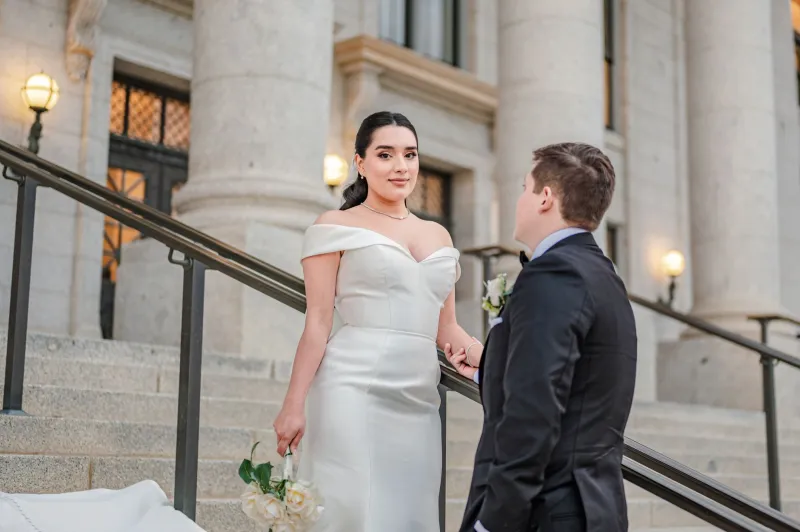
Same plan, earlier clock. At a December wedding the group shot wants to happen right after the confetti and before the light drops — usually somewhere between 2.30 and 3.30pm in the UK. I'll stage the doorway or the covered archway during the drinks reception, bring the couple to the front centre, and run exactly the same two-minute shape. Guests are still warm from the ceremony, the coats are still off, and the light is as good as it's going to get all day.
Two minutes. One shape. Everyone in. Then the camera comes down and the party gets on with being a party — which is, after all, what everyone came for.