The Town at Six O'Clock: Photographing Winter Street Events by Shop Light
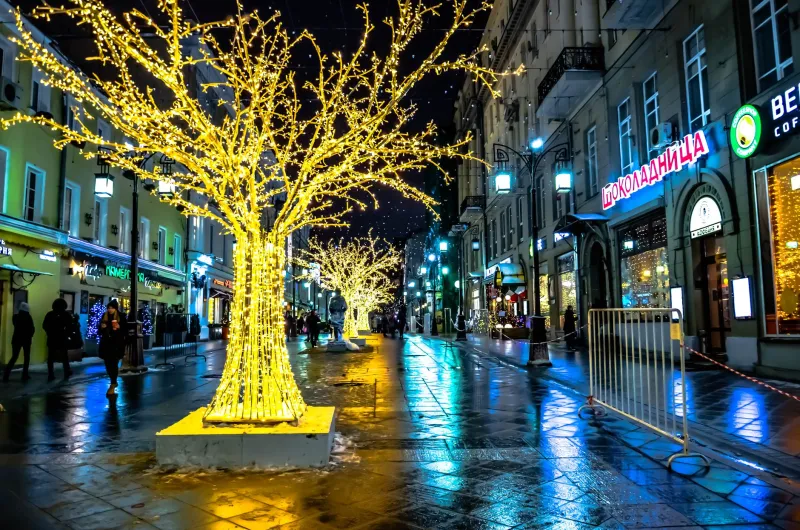
There is a particular colour to a UK high street in late November. Half past four, the sky is already a wet grey smudge, the council has hung the same strings of lights it always hangs, and someone on a temporary stage is testing a microphone with a series of dull thuds. By five the crowd is four deep at the barriers. By half past, the only light left is the kind the town makes for itself.
I photographed a switch-on in a market town last winter and barely used a flash all evening. Not out of principle, though I do have a mild one. It was simply that a burst of white light at two metres would have flattened every bit of atmosphere in the frame. The whole point of these events is the glow. Your job is to borrow it.
The light is already there, you just have to go and find it
Before the crowds arrive, walk the route. Not with a camera out, just with your eyes. You are looking for pools of usable light: a brightly lit bookshop window, the open door of a pub, a takeaway counter throwing warm yellow onto wet pavement, the lit foyer of a bank, a bus shelter with one working strip light. Estate agents are worth a look too. Their windows are aggressively, almost medically bright, and while the colour is grim, the quality is soft and directional, which is exactly what a face needs.
Mark three or four of these in your head and treat them as stations. Position your subject so the window sits at roughly forty-five degrees to their face, and the light wraps rather than hits. If there is a string of bulbs overhead, step back until it is just behind your subject's head and let it rim the shoulders. Most of the work is done before you lift the camera.
Settings that keep you moving
High ISO is not a failure, it is a decision. Anywhere between 3200 and 6400 is normal territory for a winter street event, and 12800 is fine if the alternative is a blurry child. Modern sensors handle it better than most people expect, and a little grain suits these pictures anyway.
Aperture around f/2 or f/2.8 gives you separation from the crowd without losing the scene entirely. Shutter speed of 1/125 freezes hands and faces; drop to 1/60 if you want the crowd to smear a little and the parade to feel like it is actually moving. Expose for the highlights, because fairy lights and LED shop signs blow out fast, so dial in around minus two-thirds of a stop and lift the shadows later if you need to. Shoot raw.
White balance will wobble maddeningly as you move from sodium to LED to tungsten. Set it manually somewhere around 3800 to 4200K under the main street lighting, then leave it alone. A consistent slightly-warm cast is far more pleasant than a gallery that changes temperature every four frames.
Working the parade route without becoming part of it
Lantern parades and Santa processions move, and so should you. Pick your first spot at a corner rather than the middle of the road, so the crowd becomes foreground rather than an obstacle. Shoot people walking towards you with a lit shopfront behind them, then move two hundred yards up the route and do it again.
Get low for children, whose faces are lit from below by the lanterns they are carrying. Get high, on steps or a low wall, for the wide shot that shows the whole ridiculous, lovely spectacle. And please do not step in front of the brass band to get the shot. They are playing Fairytale of New York badly and they deserve their dignity.
Candids in a crowd
A longer lens, an 85mm or 135mm, lets you shoot across the flow of people rather than into it. Look for anticipation rather than action: the child spotting the lights, the dad lifting someone onto his shoulders, the tuba player's cheeks, the woman at the stall who has clearly been standing in the cold since three o'clock.
When you are close enough to be noticed, a nod and a quick word works wonders. A simple mind if I take a quick one, said with a smile, gets a yes nine times out of ten, and a no is easy to accept. No flash in anyone's face, ever, and especially not near animals in a parade or very small children. If someone turns away, let them.
The switch-on itself, and the good bit afterwards
The countdown is four seconds of chaos and almost impossible to photograph well. Pre-focus, meter for the tree or the street rather than the sky, and shoot in bursts. The frame that usually works is the half-second after the lights come on, when every face in the crowd tilts upward at once.
Then the crowd loosens and the real pictures start. The queue for mulled wine. The chip shop with steam on the glass. Wet pavements doubling every bulb. A child asleep on a shoulder at half six. That is the stuff that makes a town feel like a town, and none of it needs a flash.
Kit, weather and a bit of common sense
Rain cover or a shower cap and a microfibre cloth in your pocket. Two batteries minimum, kept warm in an inside pocket, because cold drains them faster than you would believe. A lens hood for stray light from shop windows. And do not change lenses in the open when it is spitting, however tempting the shot.
In the edit, resist the urge to make it look like daylight. Keep the blacks black, warm the highlights a touch, cool the shadows, and let the noise be. Over-aggressive noise reduction turns faces into plastic and takes the evening out of the evening.
The town is already lit. You do not need to be.