Frost, Glass and Runner Beans: Portrait Notes for Growers in the Dead of Winter
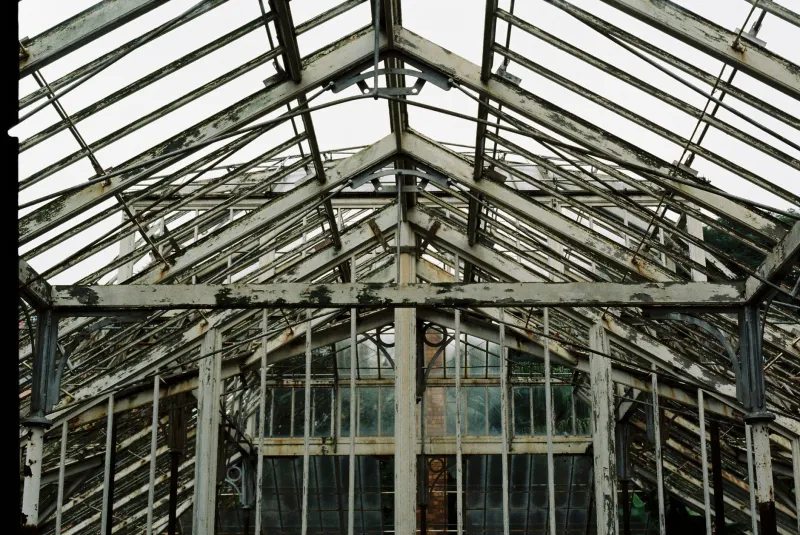
January is not the obvious month for a portrait. The light is low, the ground is hard, and most people would rather be indoors with the seed catalogues than outside pretending to be hearty. But for growers — allotment holders, small market gardeners, florists with a polytunnel, creative clients who make things from plants — the greenhouse in winter is one of the most honest settings you can photograph them in. It is quiet, a bit grubby, and full of evidence of work. That is the point.
Start with the glass, not the person
A greenhouse is a giant softbox and a giant mirror at the same time. On a clear January morning, light comes in low and sideways, skims along the benches and lands in places you would not expect. Arrive early. Walk the space before you take anything out of the bag. Look at where the light falls on a stack of pots, a watering can, the back of someone's coat. That is your set.
Do not clean the whole greenhouse. A sparkling pane is not the goal. Condensation, dust, a few fingerprints and the ghost of last summer's tomatoes are part of the story. If the glass is fogged, wipe a small patch with the side of your hand and shoot through the clear bit. If it is frosted, shoot before the sun takes it. Frost on glass is fragile and photographs beautifully when the light is behind it.
Reflections are the other thing to watch. Stand where the pane is not bouncing a bright sky straight into your lens. Sometimes a step to the left fixes it. Sometimes the reflection is the frame — the grower's face half in the glass, half in the room. Keep both options open.
The space is small; work with it
Greenhouses are cramped. There is a path, a bench, a pile of things that should have been tidied in October. Do not rearrange the place to make it look like a studio. Move yourself instead. A 35mm or 50mm lens is usually enough. Work along the bench, shoot through the doorway, stand outside and photograph back in. The doorframe gives you a natural frame and keeps the subject from feeling exposed.
Cold is a practical issue. Ask people to wear what they would actually wear to work in January, then let them keep their coat on. Nobody looks relaxed with blue hands. Build in breaks. A portrait session in a cold greenhouse should feel like a visit, not a endurance test. If there is a kettle in the shed, use it. A mug of tea is not a prop; it is central heating with a handle.
Give them a job, not a pose
The best portraits of growers happen when they are doing something small and real. Holding a bundle of seed packets. Checking a label. Tying a loose bit of string to a cane. Sorting a tray of pots. These tasks give the hands somewhere to go and stop the session turning into a line-up.
Prompts should be questions, not instructions. Ask what has survived the winter. Ask what they are planning to grow this year. Ask what they lost to the frost and whether they are still annoyed about it. Ask what they would grow if they had twice the space. You are not looking for a polished answer. You are looking for the moment they stop thinking about the camera and start thinking about beans.
That is when the face changes. The shoulders drop. The eyes go somewhere else for a second. Take the photograph then, not when they are waiting for a countdown.
For working clients — a small grower with a website to fill, a florist who needs a portrait for a market stall, a creative business built around plants — the same approach holds. Ask what they actually do. Ask what they sell and who buys it. Use the tools of the trade, but do not turn the frame into a catalogue. One good portrait of someone standing in their own greenhouse, with mud on their boots and a tray of seedlings in the background, says more than a dozen pictures of them smiling beside a logo.
Light that actually turns up in January
The usable window is short. Late morning to early afternoon is usually your best bet, but check the forecast and the aspect of the greenhouse. Clear cold light can be contrasty; move the subject a step away from the brightest pane and let the rest of the glass fill in the shadows. Overcast light is softer and easier, especially for faces, but it can go flat. In that case, use the doorway or a whitewashed wall to shape the light a little.
Backlight is your friend for frost, breath and condensation. Photograph the grower against the bright glass and expose for the face. You will lose some detail in the highlights, which is fine. The atmosphere is the point.
No flash. It flattens the glass and makes the greenhouse look like an office. Work with what is there.
The frames worth making
Start wide: the person small among the benches, the structure of the greenhouse around them. Then move in: hands, shoulders, the side of a face, a seed packet held between two fingers. Photograph the details that explain the season — frost on the inside of the pane, a label written in pencil, a pair of secateurs on the bench. Finish with a straightforward portrait at the door, looking out at the plot. It gives the story somewhere to go.
Edit with restraint. Keep the cool cast of January. Do not warm everything up until it looks like a summer advert. The honesty is in the grey light and the mud.
Why ordinary settings make better portraits
A greenhouse in January is not glamorous. That is why it works. People who grow things are used to paying attention to small changes, to waiting, to working with what the weather gives them. Put them in a setting they understand and give them something to talk about, and the camera stops being an event. It becomes a record of what they do.
That is the kind of portrait worth having on a website, in a frame, or in a family album. Not a performance. Just a person, a pane of frosted glass, and a tray of runner beans that has somehow made it through.